Singapore nurse registration in Australia: does your practice history fit?
Tips · 2026-10-12 · 9 min read
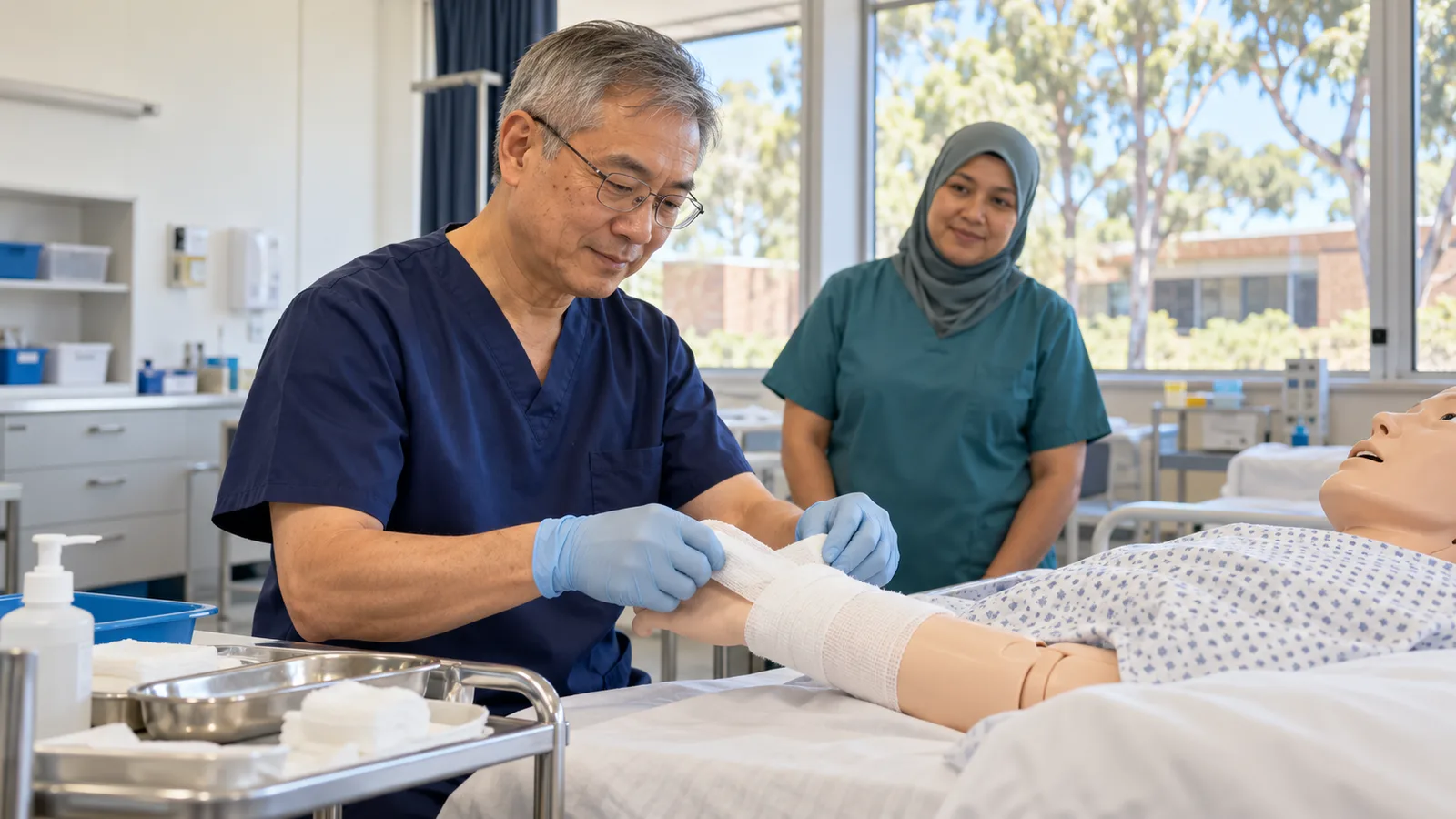
Singapore nurse registration in Australia depends on your professional history, not simply your passport or Singapore address. Singapore is an approved comparable regulatory jurisdiction under the Nursing and Midwifery Board of Australia's additional pathways for internationally qualified registered nurses, but each applicant must meet the relevant conditions. Start by organising evidence of your education, registration and practice, then check the pathway and core standards before making employment or relocation commitments.
Why your nursing history matters more than your address
The NMBA standard for internationally qualified registered nurses took effect on 23 April 2025. It provides additional pathways for eligible nurses with registration and practice in approved comparable jurisdictions; applicants outside those pathways continue through the existing internationally qualified nurse assessment process. This is established background, not a new concession announced for this archive date.
Read the NMBA standard for internationally qualified registered nurses alongside your own records. Singapore's inclusion is confirmed in the approved comparable regulatory jurisdictions list. Inclusion creates a reason to investigate eligibility. It does not establish that your application meets the conditions or that an examination exemption applies.
Separate where you trained, where you first registered and where you subsequently practised. If these are different countries, record each clearly instead of compressing the history into “Singapore nurse”. Your current residence describes where you are applying from, while your passport establishes a different part of your identity.
Make an evidence map before requesting documents
Use a working checklist to connect every claim to a record and the organisation that can confirm it. The table below is a preparation tool, not a substitute for the NMBA's application checklist. Confirm the required format, certification and delivery method before ordering documents.
| Part of your history | What to organise | Question to resolve |
|---|---|---|
| Nursing education | Exact award name, institution, study dates and available transcripts | Which education conditions does my intended pathway require? |
| Professional registration | Jurisdictions, registration categories and relevant dates | What verification must come from the regulator? |
| Clinical practice | Employment periods, clinical areas, duties and records supporting actual practice | Which parts of my history meet the pathway's practice conditions? |
| English evidence | Study records and any relevant test results | What does the registration standard accept for my circumstances? |
| Proposed employment | The advertised role, your application and any written offer | What registration and work-rights conditions remain outstanding? |
For a Singapore polytechnic or university award, retain the title printed on the document. Do not rename it as an Australian qualification to make a CV sound familiar. If further study followed your initial nursing qualification, show the sequence rather than allowing the later award to obscure the education that led to registration.
Keep employer testimonials separate from regulator correspondence. A testimonial can help explain what you did, but it is not the same kind of evidence as confirmation of professional registration. Ask the receiving authority which organisation must supply each item and whether applicant-uploaded copies are sufficient.
Describe clinical practice without overstating it
Build a chronological work record before writing the polished application. Record the clinical setting, employment dates, your actual responsibilities and who can confirm them. Where a job combined clinical, education or administrative duties, describe the mix truthfully rather than treating every period as identical nursing practice.
Check consistency across your CV, employment records and registration history. Explain an apparent gap or change of title using the records you hold; do not adjust dates to create a continuous timeline. Ask potential referees whether they can confirm the duties and period you intend to describe before sharing their contact details.
A general statement such as “experienced in patient care” tells an employer little about your contribution. Describe the work you actually performed, the setting and the responsibility you held, without including patient identifiers or confidential case material. Keep these descriptions separate from any claim that an Australian authority has already accepted your experience.
You can use Build AI CV to organise your nursing education and employment history. Check every generated sentence against your own records, particularly job titles, dates and registration status. A well-presented CV supports an application; it is not an assessment decision.
Treat English evidence as a separate task for each authority
The NMBA's core standards, including English, still apply to applicants using the additional pathways. Do not treat routine professional use of English in Singapore as a finding that you meet the registration standard. Read the standard for your circumstances and identify which records you need.
Visa English evidence is a separate question. The subclass 482 rules include an exemption based on at least 5 years of full-time secondary-or-higher study where most classes were taught in English, supported by documentary evidence. Check the Home Affairs subclass 482 English requirements before relying on that exemption.
If you intend to rely on study, organise the dates, institutions and available evidence of the teaching language. Ask for clarification where the records do not establish the relevant condition. A visa exemption must not be presented as an NMBA exemption, and an employer's satisfaction with your communication does not decide either question.
Registration, recruitment and immigration need different answers
Track the professional, employment and immigration decisions separately. For registration, the question is whether you meet the NMBA's requirements. For recruitment, it is whether your experience fits the employer's role; for immigration, it is whether the applicable visa requirements are met.
The Skills in Demand visa, subclass 482, involves employer sponsorship and nomination for an eligible position. A nursing registration outcome does not replace those requirements. Most visa applicants must also meet Australia's health requirement, which is separate from demonstrating professional competence.
For route-specific preparation, use our Skills in Demand visa guide. Keep any job-search timetable flexible while decisions remain outstanding; our article on planning from Singapore around Australia's visa queue provides context, rather than a personal processing forecast.
Compare duties in the registered nurse listing in Wagga Wagga and the community registered nurse listing in Darwin. Read each vacancy's current conditions before applying; the presence of a listing does not establish your registration, selection or sponsorship outcome.
A practical preparation sequence from Singapore
- Identify the professional route. Read the current NMBA standard and compare its conditions with your education, registration and practice history. Record uncertainties for clarification instead of assuming the additional pathway applies.
- Inventory the evidence already available. Separate qualification records, employment material and regulator correspondence. Mark missing or inconsistent information before asking institutions or employers for replacements.
- Confirm submission requirements. Check which documents need verification, who must send them and the accepted format. Avoid commissioning a generic document package without knowing what the recipient needs.
- Resolve English evidence. Maintain distinct notes for registration and the proposed visa. Confirm the applicable evidence route before making a test booking or claiming an exemption.
- Prepare accurate job applications. Match your actual experience to the duties and state your registration status precisely. Ask how any outstanding requirements affect the proposed commencement arrangements.
- Review commitments before departure. Reconcile the registration position, written employment terms and visa position before resigning or making inflexible travel commitments. Keep copies of decisions and correspondence together.
Build a budget from costs you have actually confirmed. Use separate lines for registration-related expenses, document preparation, any required testing, visa costs and relocation, rather than treating one application charge as the whole move. Our guide to budgeting beyond an Australian visa fee helps organise that discussion without assuming a particular amount applies to you.
Common mistakes when preparing a nursing move
- Substituting residence for professional history. A Singapore address does not show where you qualified, registered or practised. Record those details individually.
- Promising yourself an assessment waiver. Comparable-jurisdiction status is subject to pathway conditions. Do not describe every nurse registered in Singapore as automatically eligible.
- Presenting RPL as practice permission. A qualification or RPL does not make you a registered nurse or an enrolled nurse in Australia. Registration remains a separate requirement.
- Using a visa English exemption for registration. Check each authority's standard rather than recycling an answer from the other process.
- Reading workforce demand as personal eligibility. Our article on interpreting Australian workforce figures from Singapore explains the planning context. National figures cannot replace an individual registration or hiring decision.
Frequently asked questions
Does a Singapore passport make me eligible for an additional NMBA pathway?
No. Singapore appears on the approved comparable regulatory jurisdiction list, but the pathway concerns professional history rather than citizenship. Check the conditions against your nursing education, registration and practice; living in Singapore or holding its passport is not enough.
Can I assume my Singapore nursing registration removes all further assessment?
No. The additional pathways have eligibility conditions, and the existing internationally qualified nurse assessment process remains relevant for people outside them. Core registration standards, including English, continue to apply, so do not describe your application as exempt before checking the applicable requirements.
Will my English-medium education satisfy both registration and visa requirements?
It may provide relevant evidence, but each authority applies its own rules. The subclass 482 study exemption concerns at least 5 years of full-time secondary-or-higher education with most classes taught in English and requires documentary support. Meeting that visa exemption does not establish that you meet the NMBA English standard.
Can RPL or another qualification make me a registered nurse in Australia?
No. A qualification or RPL does not make you a registered nurse or an enrolled nurse in Australia. Recognition of prior learning, educational awards and professional registration serve different purposes; check the NMBA registration process before treating any training outcome as permission to practise.
What should I tell an employer while my registration application is unfinished?
State the stage accurately and distinguish documents gathered, an application submitted and a decision received. Describe your actual clinical experience and identify any outstanding registration or visa matters affecting a proposed start. An employer conversation does not settle those decisions, so ask for any conditions in the offer to be recorded clearly.
Key takeaways
- Singapore's comparable-jurisdiction status matters only alongside the relevant professional history and pathway conditions.
- Preserve exact qualification names and distinguish education, registration and practice evidence.
- Check registration English and visa English separately.
- Keep recruitment, registration and immigration decisions visible before committing to a move.
- A qualification or RPL cannot replace Australian nursing registration.
Last checked: 2026-10-31 against the official pages linked above.
For advice on your individual visa circumstances, book a consultation with a registered migration agent (MARA) for Australia. The agent can assess the immigration questions; the nursing regulator determines professional registration.
#singapore #nurse registration #australia #nmba #ahpra #nursing evidence
 Australia trade interview questions: make Singapore experience clear
 Welding experience in Singapore? Look beyond Australia’s shortage headline
 Your Singapore trade skills may travel: what should you check before Australia?